How Research Funding Helped Transform Lung Cancer Harboring EGFR mutation into a Manageable Disease

By Dhru Deb, PhD
Senior Director, Research and Administration, LCRF
For more than two decades I have been watching the field of lung cancer harboring EGFR mutation evolve from a mystery to a map, from a crisis to something many patients now live with for years.
Before we begin, an important note: the EGFR-mutation in lung cancer is one of the most extensively studied areas in oncology. What follows highlights selected milestones and investigators—particularly those supported by the Lung Cancer Research Foundation (LCRF)—but it is not a comprehensive history. Many other scientists, clinicians, collaborators, and, most importantly, patients, have driven this progress forward. Their contributions are deeply valued, even if not individually named here.
When There Was Nothing
In the early 2000s, a lung cancer diagnosis often arrived with a quiet finality. The doctor might speak gently, choosing words like “aggressive,” while the details blurred together in the shock of the moment.
Sometimes the patient had never smoked. Sometimes they were in their early fifties, with a persistent cough that seemed ordinary at first—just something that wouldn’t go away. That was often how it began.
Back then, lung cancer was treated largely as one disease. Chemotherapy was the standard approach. Some patients responded. Many did not. There was no routine testing to look inside the tumor’s DNA. There was no roadmap.
Outcomes were often swift and unforgiving.
Family members would later learn that their loved ones likely had what we now call lung cancer harboring EGFR mutation—a subtype driven by specific changes in a gene called the epidermal growth factor receptor (EGFR). But in 2003, that knowledge had not yet reached the clinic.
2004: The Spark
In 2004, several research teams—including Thomas Lynch Jr., William Pao, Bruce Johnson, Tetsuya Mitsudomi, Katerina Politi, Mark Kris, Susumu Kobayashi, Pasi Jänne, Matthew Meyerson, Balázs Halmos —published landmark papers in The New England Journal of Medicine, PNAS USA, and Science. They identified specific EGFR mutations—most commonly exon 19 deletions and the L858R mutation—that made tumors exquisitely sensitive to drugs called EGFR tyrosine kinase inhibitors (TKIs).
For the first time, lung cancer was no longer one disease.
It was as if researchers had discovered that some tumors were powered by a single stuck accelerator pedal—and that there might be a way to ease off it.
Turning Discovery into Certainty
Science moves forward because someone asks, “But how does it really work?”
Raffaella Sordella, supported early by LCRF, helped answer that question. Her work explored what scientists call “oncogene addiction”—the idea that certain cancers become biologically dependent on a single mutated pathway for survival.
Her research showed that EGFR mutations weren’t just markers that happened to predict response. They were the engine itself.
That biological clarity mattered. It gave physicians confidence that targeting EGFR wasn’t guesswork—it was rational medicine.
The First Breakthroughs in the Clinic
By 2009, the phase III IPASS trial (Mok et al., NEJM 2009) demonstrated that patients with EGFR mutations responded far better to EGFR inhibitors than to chemotherapy. Japanese trials such as NEJ002 and WJTOG3405 confirmed it (Mitsudomi et al., Lancet Oncology, 2010).
Testing tumors for EGFR mutations became essential.
Marc Ladanyi, also supported by LCRF, helped build the genomic infrastructure to make that testing reliable and routine. Without accurate molecular diagnostics, these scientific breakthroughs would never have translated into real lives extended.
For patients diagnosed in 2011—the difference was immediate. Instead of starting chemotherapy, they began erlotinib after their tumor tested positive for an EGFR mutation.
In some cases, within weeks, their cough eased. Their scans improved dramatically.
For the first time, some patients were experiencing what felt like a miracle: pills instead of IV chemotherapy. Tumors shrinking in months, not after endless cycles.
The Setback: Resistance
But cancer adapts.
By 2015, many patients who initially responded began to relapse. Researchers identified a common culprit: a secondary mutation called T790M.
It was heartbreaking. For patients who had tasted hope, progression felt devastating.
Katerina Politi, supported by LCRF, used genetically engineered mouse models to show that resistance was not random chaos. It was evolution under pressure. Tumors changed in predictable ways.
Trever Bivona’s work expanded that understanding further, revealing that resistance could arise through “bypass” pathways—like traffic detours around a blocked road.
The message was profound: resistance wasn’t failure. It was biology. And biology could be studied.
Osimertinib: A Second Chance
Scientists designed a third-generation drug—osimertinib—to specifically target the T790M resistance mutation while sparing normal cells.
The AURA trials and later the FLAURA trial (Soria et al., NEJM 2018; Ramalingam et al., NEJM 2020) showed improved progression-free and overall survival. Osimertinib became the first-line standard of care.
Jonathan Ostrem’s research into mutant-selective drug design helped refine how these targeted therapies bind precisely to altered proteins—like crafting a key that fits only the damaged lock.
For some patients, when their cancer progressed in 2016, a blood test—called a liquid biopsy—detected T790M in circulating tumor DNA. They switched to Osimertinib and their disease came under control.
When Cancer Changes Identity
Yet even osimertinib is not the end of the story.
Some tumors develop additional changes—MET amplification, C797S mutation, or even transform into a different type of cancer, such as small cell lung cancer.
Matthew Niederst, supported by LCRF, helped define this phenomenon of lineage plasticity—the idea that cancer cells can change identity under treatment pressure.
It was a sobering realization: cancer is not static. It evolves.
But now doctors monitor it in real time. Liquid biopsies, advanced genomic profiling, and structured sequencing strategies—refined by clinicians like Zofia Piotrowska—help guide what comes next.
Today, options after resistance include:
- Bispecific antibodies
- Antibody–drug conjugates
- Fourth-generation EGFR inhibitors in development
- Rational combination therapies
What once was a cliff is now, increasingly, a series of steps.
From Months to Years
Two decades ago, a lung cancer harboring EGFR mutation diagnosis often meant months.
Today, many patients live years. Brain metastases—once especially devastating—can often be controlled with targeted treatments designed to cross into the central nervous system. As cancers evolve, patients may move through sequential targeted therapies, each tailored to new molecular changes. Quality of life, once an afterthought in the urgency of treatment, has become a central goal alongside longevity.
The journey is rarely simple. Patients may cycle through multiple lines of therapy. There are setbacks, scans that bring anxiety, and difficult decisions along the way. But there are also birthdays once feared lost, holidays once thought unreachable, futures that expand beyond the original prognosis.
For families who lost loved ones before these advances, the grief does not vanish. It lingers, reshaped but enduring. Yet many find meaning in witnessing how profoundly the story has changed—how scientific discovery has transformed a once-uniform diagnosis into a series of treatable, evolving chapters. And in that transformation, there is both remembrance and hope.
What This Means
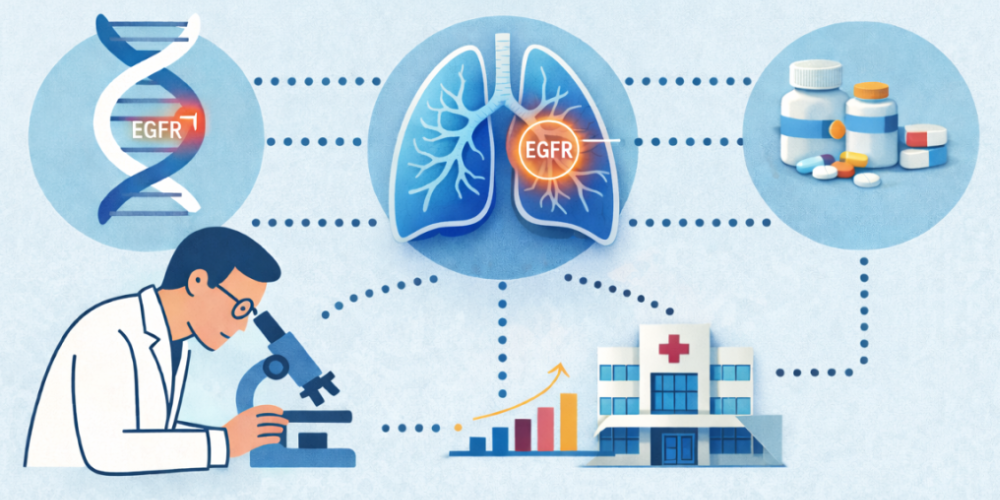
The transformation of Lung cancer harboring EGFR mutation reflects a complete arc of translational science:
- Foundational molecular discovery
- Diagnostic implementation
- Resistance biology
- Evolutionary modeling
- Precision drug design
- Clinical sequencing strategy
LCRF’s sustained investment helped accelerate each step—supporting scientists willing to ask difficult questions before the answers were obvious.
For families who lost loved ones before these therapies existed, this progress carries both sorrow and meaning. For patients diagnosed today, it offers something once unimaginable:
Time. Options. Hope.
The story of lung cancer harboring EGFR mutation is not finished. Resistance still occurs. Cure remains elusive. But what was once a rapidly fatal disease is now, for many, a chronically managed condition guided by molecular insight.
And every breakthrough rests on decades of research—and on the patients, donors, advocates and research partners who made that research possible.
Because science does not move forward alone.
This article originally appeared on LinkedIn.