From Discovery to Durability: The ALK Lung Cancer Breakthrough—and the Research That Made It Possible

By Dhru Deb, PhD
Senior Director, Research and Administration, LCRF
In 2007, researchers identified a new genetic driver in a small but significant subset of non–small cell lung cancer (NSCLC): a change in the structure of a chromosome that accidentally joins two genes—EML4 and ALK—together, creating what is known as the EML4-ALK fusion. For patients—often younger, never- or light-smokers—this discovery offered something rare in lung cancer at the time: a clear molecular target.
The first drug to successfully target ALK-rearranged lung cancer was crizotinib. Initially developed for a different target, it produced dramatic tumor shrinkage in patients whose cancers harbored ALK fusions. Clinical trials including PROFILE 1007 and PROFILE 1014 demonstrated superior response rates and longer progression-free survival compared with chemotherapy. In 2011, crizotinib received FDA approval.
For patients, this was transformative. Tumors that had been growing rapidly began shrinking within weeks. Symptoms improved.
But as with nearly all targeted therapies, the benefit did not last forever. Within one to two years for most patients, the cancer returned. Some tumors acquired new mutations in the ALK gene itself. Others activated alternative signaling pathways. Many spread to the brain, where crizotinib had limited penetration.
Understanding why resistance happened—and how to overcome it—became the next urgent frontier. This is where Lung Cancer Research Foundation (LCRF) mediated visionary donors’ intentions to support research that made a crucial difference.
- In 2009, Dr. Susumu Kobayashi at Beth Israel Deaconess Medical Center launched LCRF-funded research to identify mechanisms of resistance to ALK inhibitors. His work helped define secondary ALK mutations as actionable drivers of relapse, creating a roadmap for designing next-generation inhibitors that could overcome them.
- In 2010, Dr. Christine Lovly at Vanderbilt University Medical Center focused her LCRF-supported research on developing novel therapeutic strategies for ALK-fusion–positive lung cancer. Her work contributed to understanding how resistance pathways emerge and how they might be targeted.
- In 2011, Dr. Magda Stumpfova at the Dana-Farber Cancer Institute identified CRKL as a new way cancer cells can become resistant to treatment. Her research showed that resistance doesn’t always happen because the original target of the drug changes. Instead, cancer cells can sometimes switch on alternative signaling routes inside the cell—essentially finding a workaround—that allow them to keep growing even when ALK is being blocked.
- In 2012, Dr. Adam Crystal at Massachusetts General Hospital tested combination drug approaches in models of crizotinib-resistant disease, helping validate the concept that dual targeting strategies might delay or overcome resistance.
These projects were launched at a time when resistance biology was only beginning to be mapped. Their findings informed both laboratory science and clinical strategy.
Armed with deeper knowledge of resistance mutations and the need for brain-penetrant therapies, drug developers created more potent next-generation ALK inhibitors, including alectinib, brigatinib, and ceritinib.
The ALEX trial demonstrated that alectinib was superior to crizotinib in the first-line setting, significantly extending progression-free survival and dramatically improving control of brain metastases. Similarly, the ALTA-1L trial established brigatinib as another powerful first-line option.
These advances translated into meaningful gains for patients. The risk of cancer spreading to the brain dropped substantially. Remissions lasted longer. Five-year survival rates rose to levels rarely seen in metastatic lung cancer.
As second-generation inhibitors became standard, new resistance patterns emerged, including complex and compound ALK mutations. Researchers needed an even more sophisticated inhibitor.
That drug was lorlatinib, engineered to overcome the most refractory resistance mutations and to penetrate the central nervous system effectively. In the CROWN trial, lorlatinib demonstrated unprecedented efficacy as first-line therapy, with remarkable durability and brain protection. It subsequently received FDA approval.
The ability to design lorlatinib rationally—to anticipate the mutations it needed to overcome—was made possible by years of resistance research, including early LCRF-supported studies.
As multiple ALK inhibitors became available, a new question emerged: which drug should be used first, and how should therapy be sequenced after resistance develops?
In 2018, Dr. Satoshi Yoda at Massachusetts General Hospital received LCRF funding to study how to tailor treatment for ALK-positive lung cancer. His work focused on defining mutation-specific sensitivities, helping clinicians better match particular resistance mutations with the most effective next inhibitor. This research contributed to growing efforts to guide treatment choices based on the specific resistance mutations present in a patient’s tumor.
However, as patients began living longer, new forms of resistance became apparent—some not driven by new genetic mutations. This is when LCRF supported the next phase of research projects.
- In 2022, Drs. Álvaro Villalonga and Esther Resano at Memorial Sloan Kettering Cancer Center began investigating epigenomic mechanisms of resistance to ALK-targeted therapies. Their research explores how changes in chromatin and gene regulation may allow tumors to adapt to the constant presence of these drugs and continue growing despite treatment.
- That same year, Dr. Jaime Schneider at Massachusetts General Hospital launched research into metabolic reprogramming as a driver of resistance in ALK-positive lung cancer, examining how cancer cells alter their energy use to adapt.
These studies aim to understand how tumors can change and adapt over time, and to identify weaknesses in cancer cells beyond the specific part of the ALK protein that current drugs are designed to block.
When ALK rearrangements were first discovered, metastatic lung cancer carried a grim prognosis. Today, many patients with ALK-positive disease live for years—sometimes a decade or more—with sequential targeted therapies controlling their cancer.
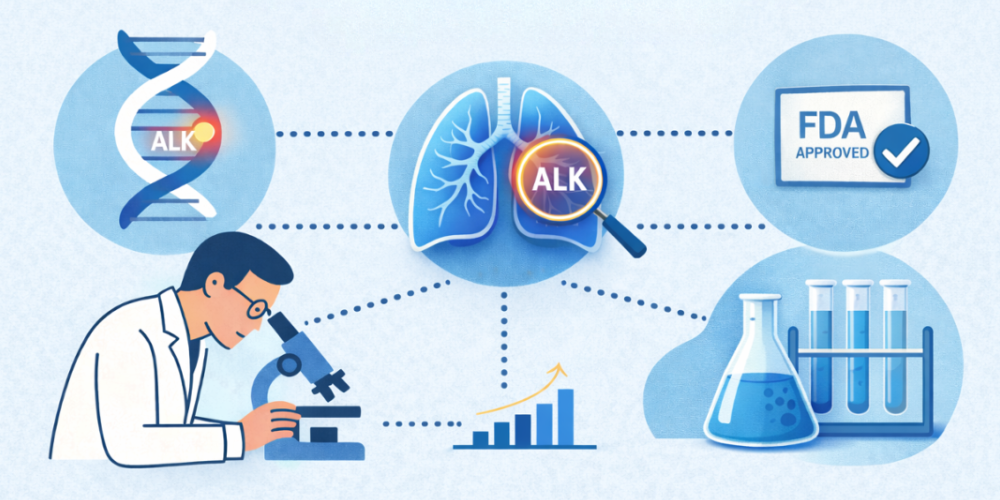
This transformation did not occur in a single leap. It unfolded in stages: discovery, clinical validation, FDA approval, resistance, redesign, and renewal. At each stage, investigators supported by LCRF contributed critical insights—often before the field fully understood their importance.
And the work continues—because the arc of discovery, once set in motion, does not stop —and neither do the people whose lives it has changed.
This article originally appeared on LinkedIn.
In 2026, LCRF will launch a dedicated ALK+ research funding opportunity. We need your help to make it happen! Find out more at LCRF.org/ALK. Please donate and help us reach our goal of $130,000 by May 1.