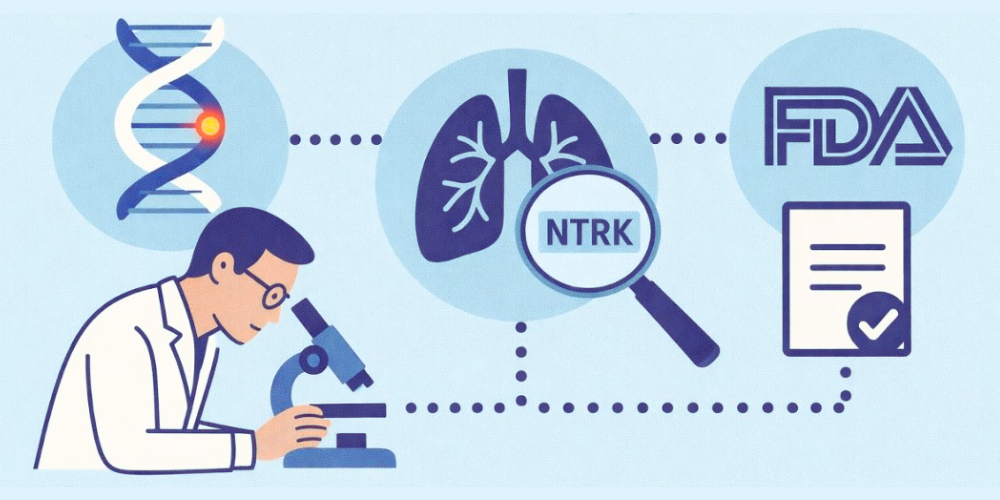
From Rare Mutation to FDA Approval for NTRK-Positive Lung Cancer

By Dhru Deb, PhD
Senior Director, Research and Administration, LCRF
NTRK gene fusions are rare oncogenic drivers, occurring in only a small fraction of lung tumors, and their rarity meant they were often overlooked in drug development. Unlike more common drivers such as EGFR or ALK, there were no targeted therapies specifically designed for patients with NTRK-driven lung cancers, leaving clinicians with limited options beyond conventional chemotherapy and making research both scientifically challenging and financially risky.
In this situation, the Lung Cancer Research Foundation (LCRF) made a prescient bet. By mediating intentions of visionary donors, in 2012 and again in 2015, LCRF awarded Young Investigator grants to Dr. Alexander Drilon, supporting his early work on rare oncogenic drivers like NTRK fusions—at a time when few believed such uncommon alterations could yield viable therapies.
When I reached out, reflecting on this partnership, Alex shared, “We really appreciate the work you are doing with LCRF as well and look forward to continuing to partner.”
That support helped generate the foundational evidence showing NTRK fusions were rare but highly actionable drivers of cancer.
Building on this early work, Dr. Drilon began leading the NAVIGATE clinical trial (NCT02576431) in 2015, testing larotrectinib, a selective TRK inhibitor, in patients with NTRK-driven tumors regardless of cancer type. For NTRK-positive lung cancer patients, the results were encouraging, with many experiencing rapid and durable responses.
As progress continued, attention turned to resistance. In 2021, Dr. Drilon and Dr. Emiliano Cocco identified a new resistance mechanism publishing their findings in prestigious Nature Medicine. As Dr. Cocco noted, “Lung cancer doesn’t stand still and neither can we.”
LCRF sustained its commitment in 2022 by funding Dr. Cocco’s ongoing work to refine treatment strategies.
The impact of this long-term investment became clear in 2025, when NAVIGATE demonstrated clear clinical benefit and the FDA fully approved larotrectinib for NTRK-positive tumors, following its accelerated approval in 2018—the first targeted therapy for this rare driver. What began as a high-risk idea ultimately reshaped care for an underserved group of lung cancer patients, showing how early funding can ensure that even patients with rare cancers are not left behind.
This article originally appeared on LinkedIn.