
By Dhru Deb, PhD
Senior Director, Research and Administration, LCRF
I wrote this article in response to a request from Enrico Peretti of Milan, Italy, who recently reached out to us with a deeply personal question about research progress in KRAS-mutant non-small cell lung cancer (NSCLC).
“Good evening, thanks for your page, which is really informative. Can you kindly post more often about research advancement or news in NSCLC KRAS mutation, and especially pG12C? My mom passed away last October due to this specific cancer, so I am particularly eager to research advances in this context. Also, as far as I know—please correct me if I am wrong—this is one of the most diffuse lung cancers; however, the conversation is usually polarized towards EGFR and ALK.”
Enrico’s words reflect a reality faced by many families: the search for answers often comes too late for someone they love. His question—what progress is being made, and why does it matter—goes to the heart of why research exists in the first place.
KRAS mutations are among the most common drivers of lung adenocarcinoma. Yet for decades, they were also among the most frustrating. Scientists were aware of and they understood its role in fueling cancer growth, but they could not effectively target it. For patients, that gap between knowledge and treatment meant limited options—and limited hope.
Today, that reality is changing.
Building the scientific foundation
The progress now reaching patients did not begin with a breakthrough drug. It began years earlier, with fundamental questions about KRAS biology and the willingness to pursue the research to answer them.
In the mid-2000s, Lung Cancer Research Foundation (LCRF) mediated visionary donors’ intentions of supporting research to understand how KRAS mutations drive lung cancer and how these tumors might be detected and treated more precisely. At the time, this work was exploratory—far from guaranteed to succeed and not yet tied to a clear therapeutic path.
At Stanford University, Dr. Alejandro Sweet-Cordero mapped KRAS signaling pathways, helping to reveal how these tumors survive and grow. At UC Davis, Dr. Philip Mack explored detecting mutations in circulating tumor DNA—early steps toward what we now know as liquid biopsy, a tool that allows clinicians to identify actionable mutations through a simple blood test.
At Memorial Sloan Kettering Cancer Center, Drs. Yixuan Gong and Marc Ladanyi advanced genomic profiling, helping to establish comprehensive molecular testing as a standard of care. This ensured that patients could be matched with the most appropriate therapies based on the biology of their disease.
Other investigators tackled equally critical questions: how KRAS-driven tumors interact with the immune system, how they resist treatment, and how they respond to radiation. Together, these efforts formed a foundation—one that, at the time, may have seemed incremental, but ultimately proved transformative.
From discovery to direct treatment
For decades, KRAS was often described as “undruggable.” That perception shaped expectations for patients and clinicians alike.
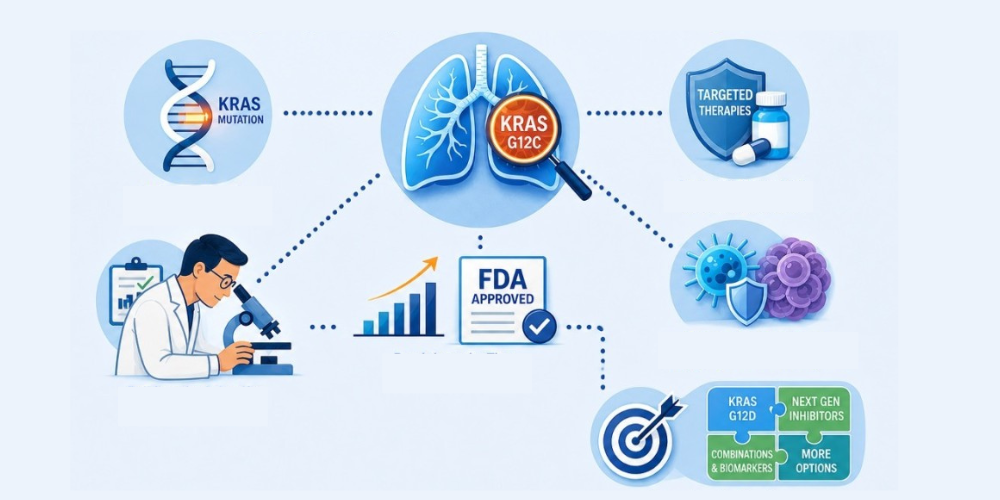
After years of persistence across the scientific community, drugs were finally developed to target a specific version of KRAS mutations called G12C, and these treatments made it into the clinic.
The CodeBreaK100 trial evaluating sotorasib and the KRYSTAL-1 trial evaluating adagrasib demonstrated meaningful clinical activity in patients with previously treated KRAS G12C–mutant cancers. The results of both trials were published in the New England Journal of Medicine leading to FDA approvals of sotorasib and adagrasib as second line therapies. For the first time, patients had therapies designed to directly target the molecular driver of their disease.
The arc of progress also reflects the growth and continued leadership of investigators supported earlier in their careers. In 2007, Dr. Pasi Jänne received LCRF’s Hope Now Award for research that contributed to the broader understanding of oncogene-driven lung cancer. Years later, he would serve as one of the investigators on the KRYSTAL-1 trial, helping to bring adagrasib to patients with KRAS G12C–mutant disease.
Similarly, Dr. Timothy Burns, previously funded by LCRF for a different project, served as an investigator in the CodeBreaK100 trial. His role in evaluating sotorasib reflects how investment in talented investigators strengthens the clinical research enterprise as a whole.
When I reached out to congratulate Tim, he replied –
“It was truly gratifying to be involved with the early phase clinical trial that led to the approval of the first targeted therapy for KRAS-mutant lung cancer after many years of investigators including myself working on trials for these patients that were unsuccessful. It has been truly rewarding to be able to treat my patients with a KRAS-mutant NSCLC with these agents.”
For families like Enrico’s, these advances can feel bittersweet—arriving after loss, yet offering hope that others may face a different outcome.
These therapies did not emerge in isolation. They were built on decades of biological insight—insight made possible, in part, by early-stage research funding. Investigators supported early in their careers have gone on to lead pivotal clinical trials, translating discovery into treatment. What begins as a high-risk research question can, over time, become a therapy that changes lives.
Facing the next challenge: resistance
Progress in cancer research is rarely linear. Each breakthrough reveals new challenges.
While KRAS G12C inhibitors have changed the treatment landscape, many tumors do not respond to treatment or eventually develop resistance resulting in disease progression.
Addressing this problem has become one of the field’s most urgent priorities.
Through the IASLC-LCRF Team Science Award, researchers including Drs. David Barbie, Aaron Hata, Eric Smith, Shunsuke Kitajima, and Pasi Jänne are working to understand and eliminate these drug-tolerant persister cells. Their approach reflects a shift in strategy: not only targeting KRAS directly, but also engaging the immune system to eradicate residual disease.
This convergence—targeted therapy combined with immunotherapy—represents a critical step toward more durable responses, and potentially, long-term remission.
In fact, olomorasib, a newer KRAS G12C drug, has shown promise in combination with immunotherapy, pembrolizumab, as a potential first-line treatment—an important step toward moving targeted therapies earlier in the course of disease, when they may have the greatest impact.
After reading the promising results published in the Journal of Thoracic Oncology, I reached out to the lead author, Dr. Timothy Burns. He said-
“The study demonstrated we could safely and efficaciously combine newer KRAS G12C inhibitors (olomorasib) with immunotherapy. The future for patients diagnosed with KRAS-mutant NSCLC is bright.”
This is a reminder of the unique role of research investment: to act as a bridge between what is known and what is possible. For patients and families, that bridge can mean the difference between having options—or not.
Expanding the frontier: new KRAS targets and new possibilities
The first KRAS G12C inhibitors were a historic breakthrough.
A new wave of therapies is now building on that progress, recognizing that KRAS-driven cancers are diverse and require tailored approaches.
In early 2026, zoldonrasib received FDA Breakthrough Therapy designation for advanced non–small cell lung cancer driven by a specific KRAS mutation called G12D—one of the most common and hardest-to-treat forms of this gene. G12D refers to a small change in the KRAS protein that keeps it stuck in an “on” position, helping cancer grow. This drug was designed as a potential first-of-its-kind treatment that targets KRAS while it’s active. Other experimental drugs, including D3S-001 and elironrasib, are being studied to help overcome resistance and keep working even after earlier treatments stop being effective.
Together, these advances mark a shift from proving KRAS can be targeted to refining how, when, and for whom these therapies work—offering patients and families a rapidly expanding set of possibilities.
For families still waiting
Enrico’s question—why more attention isn’t always given to KRAS, despite its prevalence—is an important one. Historically, the lack of effective targeted therapies meant less progress. Today, that is changing, as scientific research results in the advancement of cancer treatment.
But the deeper truth behind his message is this: progress matters most when it reaches patients in time.
This is one of the motivations of Dr. Lyudmila Bazhenova, an investigator in the KRYSTAL-1 trial, and a member of LCRF’s Education & Engagement Committee. This committee ensures LCRF delivers relevant, helpful educational content that meets the needs of the lung cancer community and is readily accessible to inform and empower individuals throughout their journey.
The advances in KRAS-mutant lung cancer are real and meaningful. They are already improving outcomes for many patients. And yet, there is more to do—to overcome resistance, to expand treatment options, and ultimately, to move closer to cures.
For every family searching for answers today, the work continues with urgency and purpose.
Because behind every scientific question is a human one.
And behind every investment in research is the possibility of changing what families like Enrico’s experience in the future.
This article originally appeared on LinkedIn.