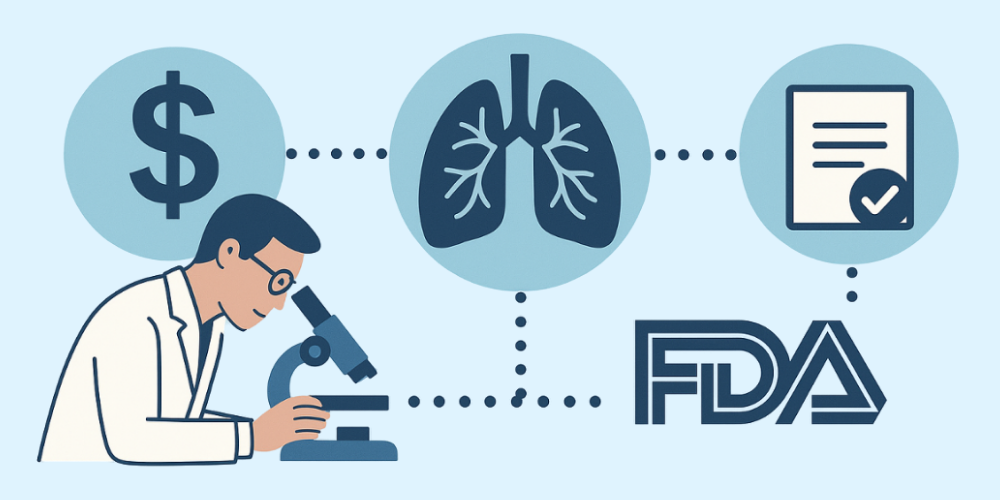
Early Research Funding and Recent FDA Approval of Immunotherapy for Small Cell Lung Cancer

By Dhru Deb, PhD
Senior Director, Research and Administration, LCRF
Every so often in cancer research, you experience a moment where everything clicks: years of individual projects, grants, and hypotheses suddenly line up and reveal a bigger story. I felt that recently while tracing the path from the Lung Cancer Research Foundation‘s early investments in small cell lung cancer (SCLC) to the FDA approval of durvalumab in 2024.
And the more I dug in, the clearer it became. This breakthrough didn’t appear out of thin air. It grew directly out of the seeds planted more than a decade ago.
Back in 2013, LCRF funded Dr. Anna Farago at Mass General to build genetically engineered mouse models of SCLC that would later become essential for testing new therapies. In 2014, LCRF supported Dr. Christine Hann at Johns Hopkins as she explored how combining targeted therapies might weaken SCLC’s defenses. These were early ideas, ahead of the immunotherapy wave.
Then came a series of grants from 2014 to 2017 focused on the PD-1/PD-L1 immune axis. At the time, this space was still emerging, especially for SCLC. But those LCRF-funded projects and investigators helped create the basic scientific understanding needed for immunotherapy to be considered for this disease.
Fast-forward to 2018, when the ADRIATIC trial launched and those early threads came together: both Anna Farago and Christine Hann were investigators on this trial. And the therapy being tested was durvalumab, an anti-PD-L1 drug.
In 2021, LCRF funded new research projects focused on figuring out how to improve durvalumab’s effectiveness in SCLC.
Then came the turning point. In 2024, the New England Journal of Medicine published results showing that durvalumab significantly improved both overall survival and progression-free survival for people with limited-stage SCLC. Months later, the FDA approved durvalumab for these patients—a truly meaningful progress in this space in decades. Looking back at the timeline, so many of the people, technologies, and ideas behind this advance could be traced to early LCRF support.
But the story doesn’t end there.
As of December 2025, Christine Hann, who is still at the forefront of SCLC research, is now involved with a new clinical trial (NCT06287775) led by Dr. Charlie Rudin, at Memorial Sloan Kettering Cancer Center. This trial is testing durvalumab combined with ladademstat, an epigenetic therapy, and it’s actively recruiting patients. It seeks to build on the success of PD-L1 inhibition by pairing immunotherapy with epigenetic modulation.
When I spoke to Charlie about the progress so far, he summed it up perfectly:
“Very exciting progress. Much more to do still!”
And he’s right. The durvalumab approval was a milestone, but it’s also a launching point.
This is just another example of the journey of scientific breakthrough. Breakthroughs like this don’t happen because of one big discovery. They happen because, over many years, visionary donors and research partners help LCRF bet early on smart researchers with bold ideas. That impact is felt deeply by people living with lung cancer—as Maida Harris Mangiameli, small cell lung cancer survivor and research advocate, echoed my sentiment:
“LCRF is very important to those of us with lung cancer.”
When we connect the dots, we see a clear, steady line from those early grants to the treatment options patients are relying on today — and hopeful for tomorrow.
This article originally appeared on LinkedIn.