Small Cell Lung Cancer (SCLC) is a challenging disease to treat, due to its aggressive and rapid growth, early metastasis, and tendency to develop resistance to chemotherapy. Many patients already have advanced (extensive-stage) disease when they are diagnosed. This is why developing more and better options for treatment is so important.
The Lung Cancer Research Foundation is committed to investing in SCLC research that leads to real progress, extending lives and improving outcomes for patients living with this disease.
If you would like additional support or personalized resources, our Lung Cancer Support Line is always available. Call (844) 835-4325 or email support@LCRF.org.
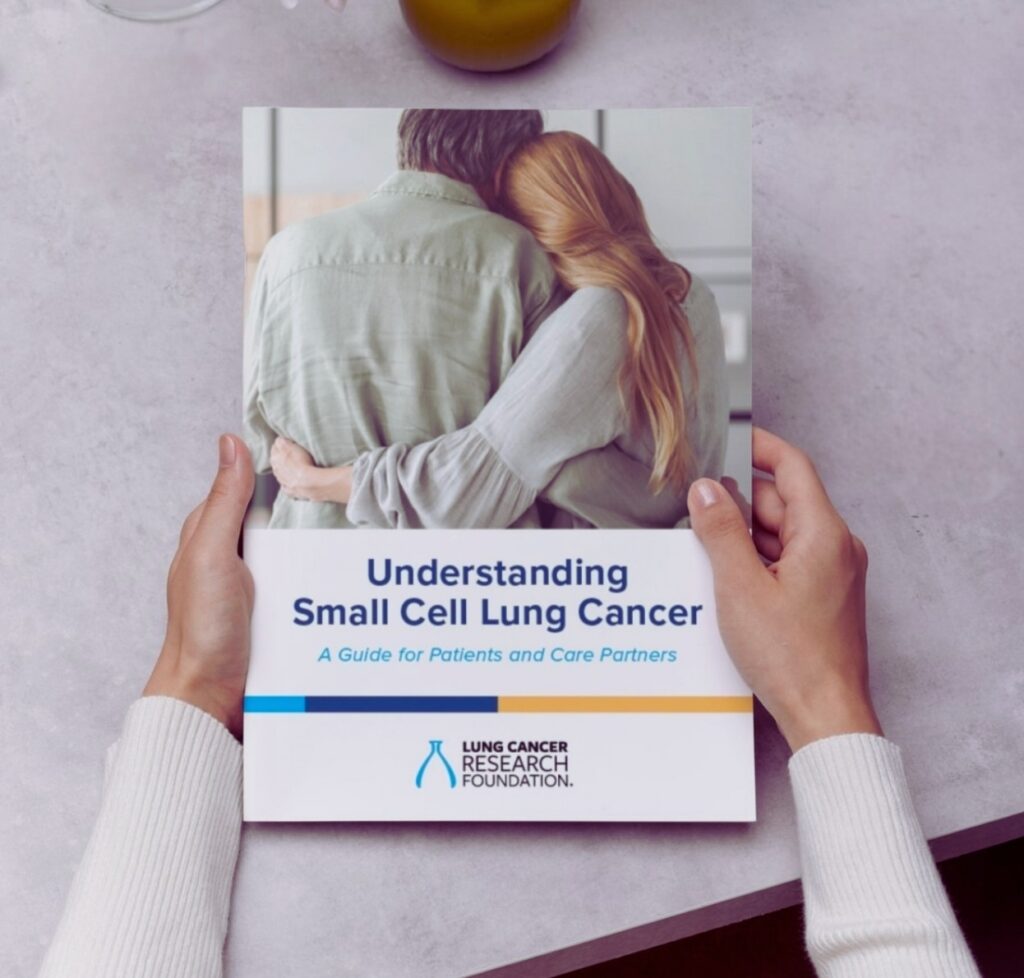
New guide to SCLC
Introducing our newly expanded and updated Understanding Small Cell Lung Cancer booklet – available now from LCRFresources.org. This publication is one of our complimentary resource materials. Download a digital version or order a printed copy (shipped free of charge in the U.S.).

On-demand education
LCRF and Medlive have partnered to help you better understand clinical trials for extensive-stage Small Cell Lung Cancer. LCRF’s Chief Scientific Officer, Dr. Toni Wozniak, Dr. Stephen Liu, and Wendy Brooks are presenters for this free, on-demand program.
SCLC news
- LCRF + AstraZeneca launch SCLC grant
 Two new research grants will accelerate discoveries in Small Cell Lung Cancer treatment.
 - Connecting the Dots: SCLC
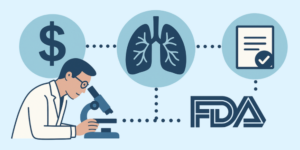 Dr. Dhru Deb traces the path from LCRF’s early investments in SCLC research to the FDA approval of durvalumab in 2024.
 - Science Update | Spring 2025
 LCRF’s science team talks about news from the 2025 AACR annual meeting.
 - Accelerated approval for SCLC treatment
 FDA granted accelerated approval to tarlatamab for extensive-stage SCLC.
 - Lambert-Eaton Myasthenic Syndrome and SCLC
 Treatment is available for LEMS, a neuromuscular disorder that is closely associated with SCLC.
 - Grantee’s work featured as journal cover story
 Work on SCLC by an LCRF grantee was the Jan. 2020 cover story in the journal Cancer Cell.
LEMS and SCLC
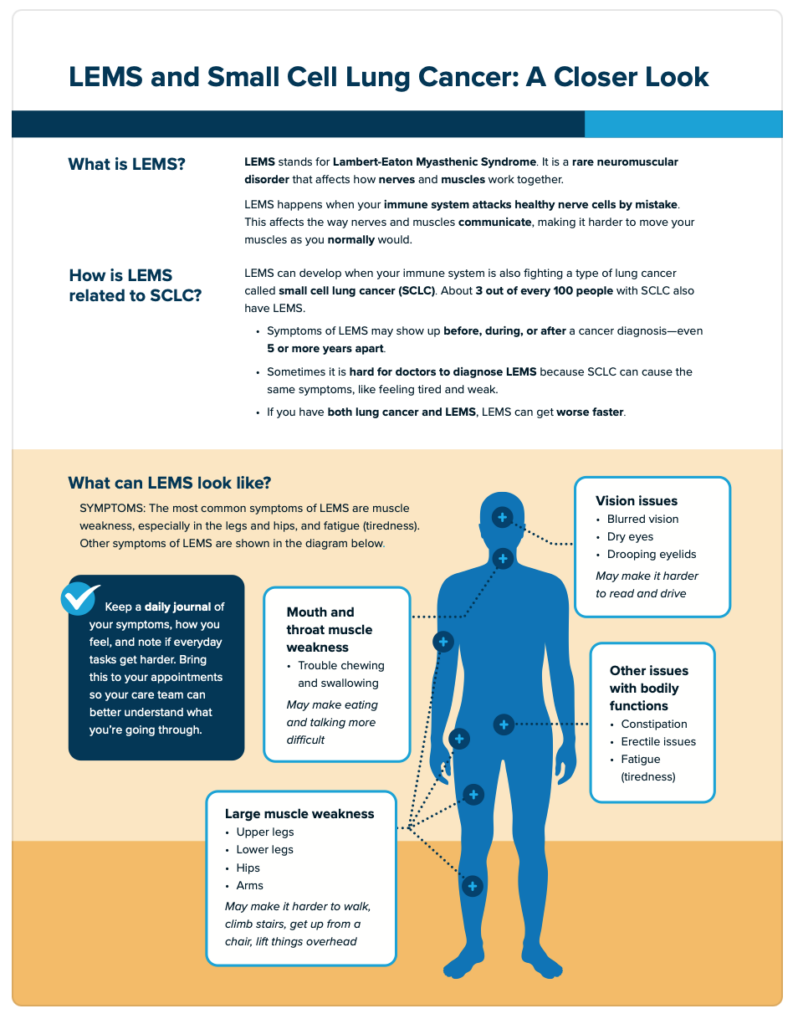
About 3 of every 100 patients with SCLC develop Lambert-Eaton Myasthenic Syndrome, a rare disorder that affects how nerves and muscles work together. Learn more at LCRF.org/LEMS.
Recent SCLC research funded by LCRF
Updated April 2026
Joseph Chan, MD, PhD
Memorial Sloan Kettering Cancer Center
2025 LCRF Leading Edge Research Grant
The goal of Dr. Chan’s study is to utilize new technologies in tandem with advanced computer modeling to improve how we predict which patients with Small Cell Lung Cancer will benefit from tarlatamab and who is at higher risk for cytokine release syndrome (CRS)—a potentially serious immune reaction that can cause fever, low blood pressure, and difficulty breathing. Grant details
Lu Wang, PhD
Northwestern University Feinberg School of Medicine
2025 LCRF Leading Edge Research Grant
Joan H. Schiller, MD Award for Scientific Merit
Dr. Wang’s previous research focused on identifying a factor known as the BAP1/ASXL3 complex, which regulates one of the most predominant molecular subtypes of small cell lung cancer by controlling its gene expression patterns. As a result, they screened and optimized small-molecule drugs that could target this complex by inhibiting its function and promoting its breakdown. This approach significantly reduced tumor progression in cells and animal studies targeting small cell lung cancer. The current study focuses on a new factor named MBD6, which is able to stabilize the oncogenic BAP1/ASXL3 complex. Grant details
Carl Gay, MD, PhD
University of Texas M.D. Anderson Cancer Center
2023 LCRF–Daiichi Sankyo–AstraZeneca Research Grant on Antibody Drug Conjugates
Dr. Gay is evaluating targeted therapies for small cell lung carcinoma (SCLC) and large cell neuroendocrine lung cancer—both of which remain difficult to treat. His research focuses on two biomarkers, HER2 and TROP2, which are expressed in these aggressive cancers. Dr. Gay’s team is evaluating antibody-drug conjugates (ADCs), a promising treatment approach that uses antibodies to deliver chemotherapy directly to cancer cells. Grant details
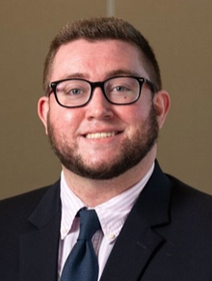
Benjamin Morris, PhD
University of Texas M.D. Anderson Cancer Center
2023 LCRF Leading Edge Research Grant Program
Dr. Morris is leading critical research to better understand how small cell lung cancer (SCLC) responds to treatment by analyzing patient tumor samples before, during, and after therapy—particularly when the cancer progresses. His team is also comparing the genetic makeup of tumors in patients who respond well to treatment versus those whose cancer proves resistant. Grant details
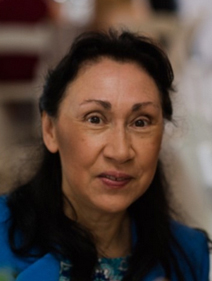
Ann Pendergast, PhD
Duke University School of Medicine
2023 LCRF Research Grant on Understanding Resistance in Lung Cancer
Dr. Pendergast is conducting groundbreaking work to uncover new ways to treat therapy-resistant small cell lung cancer (SCLC). Her research focuses on understanding how cancer cells communicate at the molecular level, specifically through RNA messages. Her team has identified ABL, a proto-oncogene that supports cancer growth, as a key target. Grant details
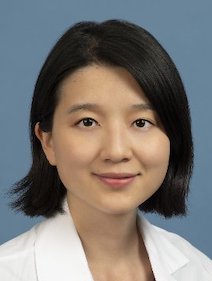
Bingnan Zhang, MD
University of Texas MD Anderson Cancer Center
2022 Lung Cancer Research Foundation Pilot Grant
Chimeric antigen receptor (CAR) T-cell therapy modifies a patient’s own immune cells to target and kill cancer cells. Dr. Zhang and her team have developed a novel CAR T against a SCLC surface protein target DLL3. Her team is investigating the efficacy of the DLL3 CAR T and its potential resistance mechanisms in patient-derived mouse models. The goal of this research is to ultimately inform the design of clinical trials using DLL3 CAR T and its combination approaches to benefit patients with SCLC. Grant details